Persistent blockage, hearing change, throat symptoms, or a neck lump does not always mean you need an operation, but the right specialist can prevent months of unsuitable treatment. By the end, you will know when to seek an ENT surgeon, when an endoscopic examination helps, which warning signs need urgent care, and what to ask during a consultation.
Key takeaways
- Start with primary care for uncomplicated colds, allergies, and minor ear complaints.
- Seek urgent assessment for breathing trouble, severe bleeding, or sudden hearing loss.
- Ask what the endoscopy examines and whether it changes your treatment plan.
- Compare training, diagnostic facilities, treatment options, and follow-up access.
Should you start with an ENT surgeon or another clinician?
Start with a primary-care doctor for a straightforward cold, seasonal allergy, uncomplicated sore throat, or minor ear complaint. Choose the clinician whose training matches the problem:
| Clinician | Best starting point | What they do |
|---|---|---|
| Primary-care doctor | Common, uncomplicated symptoms | Treats routine infections and allergies, then refers when symptoms persist or recur |
| Audiologist | Hearing difficulty, tinnitus, or hearing-aid questions | Performs hearing tests and provides hearing rehabilitation; does not assess the whole airway or perform surgery |
| Speech-language pathologist | Voice, speech, or swallowing-function problems | Assesses communication and swallowing function and provides therapy |
| General ENT physician | Ongoing ear, nose, or throat symptoms | Examines the ears, nose, throat, and neck, orders tests, and manages medical treatment |
| ENT surgeon | Structural disease, severe symptoms, or a suspected lesion | Assesses whether a procedure or operation is appropriate |
Book an ENT surgeon in Pune when nasal blockage continues despite appropriate medication, a deviated septum restricts breathing, tonsillitis keeps returning, or ear discharge is chronic. Choose an ENT surgery consultation in Pune for severe swallowing or voice problems, airway obstruction, or an examination suggesting a throat or neck lesion.
A surgeon can evaluate you without committing you to surgery. The assessment may end with medication, observation, testing, or a second opinion; surgery is only one possible recommendation. For a suspected neck or throat cancer, ask where biopsy, staging, pathology, oncology, reconstruction, and follow-up will occur.
When should you seek urgent ENT assessment?
Breathing difficulty, inability to swallow liquids, uncontrolled nosebleeding, facial weakness, rapidly enlarging neck swelling, or sudden hearing loss require prompt assessment, not an elective appointment.
Seek emergency care or same-day ENT assessment for:
- Breathing difficulty, noisy breathing, or a feeling that the airway is closing
- Inability to swallow liquids, choking, or drooling
- Nosebleeding that continues despite firm pressure for 15 to 20 minutes
- New facial weakness, especially with ear symptoms or other neurological changes
- Neck swelling that is enlarging rapidly
- Sudden hearing loss in one ear
Sudden sensorineural hearing loss can develop over up to 72 hours. Arrange rapid pure-tone audiometry and medical assessment because treatment decisions, including corticosteroids within two weeks for suitable patients, depend on confirming the loss and excluding other causes.
Book an expedited appointment with an ENT surgeon in Pune for a persistent adult neck lump, unexplained hoarseness, one-sided throat or ear symptoms, blood in saliva, or an unexplained mouth or throat ulcer.
These signs do not prove cancer, but delay can affect care; assessment may require examination, imaging, fine-needle aspiration, or referral to a head-and-neck cancer team.
A routine appointment suits mild, stable congestion, intermittent ear blockage, or a sore throat that is improving without red flags. Choose urgent care if symptoms worsen, persist, or interfere with breathing, swallowing, hearing, or neurological function.
What does an ENT endoscopist do during the first consultation?
An ENT surgeon and an ENT endoscopist usually describe different aspects of the same otolaryngologist’s work, not separate specialties. During the first consultation, the doctor identifies the likely cause of your symptoms and decides whether endoscopy or another test is useful.
Your appointment can include:
- A history of blockage, discharge, pain, bleeding, hearing change, swallowing difficulty, voice symptoms, duration, previous treatment, allergies, and medical conditions.
- Examination of the nose and throat, including the mouth, tonsils, neck, and airway.
- Otoscopy, which examines the ear canal and eardrum.
- Hearing assessment, with pure-tone audiometry, speech testing, and tympanometry when indicated.
- Review of existing CT scans, MRI scans, hearing reports, or other records.
- Flexible or rigid endoscopy when the symptoms or examination justify it.
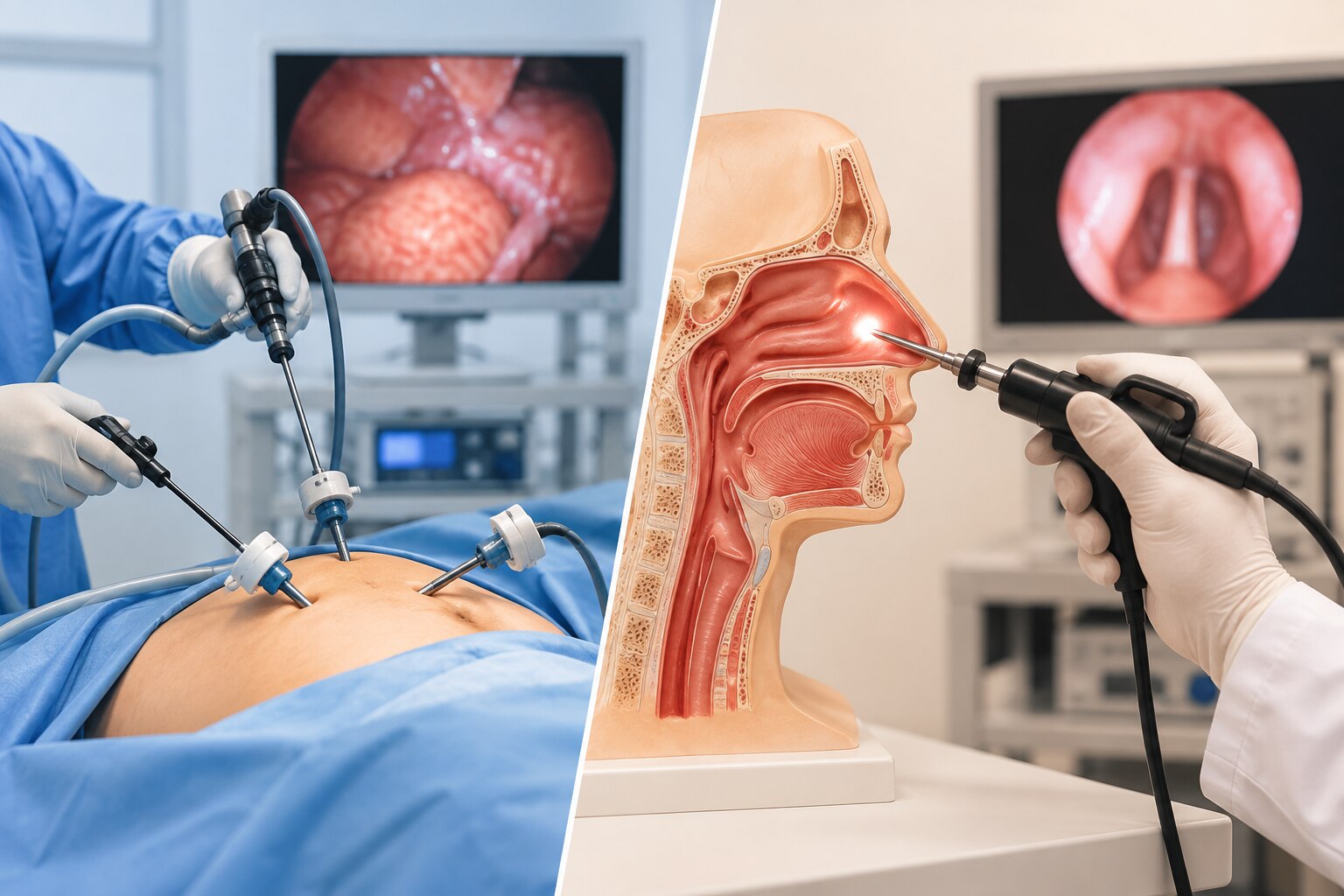
Nasal endoscopy is an office examination, not automatically an operation. A thin rigid or flexible scope can inspect the nasal passages, sinus drainage pathways, nasopharynx, and sometimes the larynx. The clinician may apply a topical decongestant and local anaesthetic first; the examination usually takes only a short time.
Endoscopy shows visible findings such as swelling, pus, polyps, bleeding points, or a mass, but it cannot diagnose every condition by itself. The result may lead to medicine, observation, further testing, or surgery.
Ask an ENT endoscopist in Pune whether the scope examination will occur in the clinic or operating room, and ask what an ENT surgery consultation in Pune would involve before agreeing to treatment.
How do doctors decide between medicine, follow-up, and surgery?
Doctors weigh duration, treatment response, examination findings, quality-of-life loss, and test results rather than choosing surgery from one symptom. Surgery becomes more reasonable when symptoms persist despite appropriate treatment, an examination identifies a correctable problem, and the condition disrupts sleep, work, eating, hearing, or breathing.
1. For chronic rhinosinusitis, you need at least 12 weeks of compatible symptoms plus objective inflammation on nasal endoscopy or CT before considering endoscopic sinus surgery. Surgery is usually discussed after medical treatment fails to control the disease.
CT helps confirm chronic inflammation and plan an operation; it is not required for every short-lived sinus episode.
2. For recurrent tonsillitis, a documented pattern of seven episodes in one year, five yearly for two years, or three yearly for three years is a reference point for tonsillectomy discussions. Modifying factors such as severe infections, abscess, sleep-disordered breathing, or missed school can change the recommendation.
3. Hearing evaluation separates conductive, sensorineural, and mixed loss. Audiometry measures thresholds, speech testing measures understanding, and tympanometry checks middle-ear function when indicated; otoscopy alone cannot establish the type or degree.
4. Suspected sleep apnoea calls for a sleep study before treatment decisions. A suspicious throat, nose, ear, or neck lesion may require biopsy and imaging, followed by oncology referral. An ENT surgeon in Pune or ENT endoscopist in Pune should explain the finding, alternatives, expected benefit, and why follow-up or surgery is safest.
How should you compare ENT surgeons and prepare for the appointment in Pune?
Before booking, ask which doctor will personally examine you, interpret the findings, perform any operation, and provide follow-up. An ENT surgeon in Pune and an ENT endoscopist in Pune may be the same otolaryngologist; “endoscopist” describes a procedural focus, not a separate specialty.
| Office endoscopy | A short examination using a flexible or rigid scope; local spray may be used | Inspection of the nose, sinus openings, throat, or larynx; it does not remove disease |
|---|---|---|
| Operating-room endoscopy | A surgical procedure under local or general anaesthesia | Sinus surgery, tumour removal, tonsillectomy, or other treatment requiring instruments and recovery |
| Follow-up endoscopy | A later check after treatment | Monitoring healing, recurrence, or persistent symptoms |
Take this checklist to the consultation:
- What is the proposed diagnosis, and what evidence supports it?
- What medicines, observation, or other procedures are alternatives?
- What benefit is realistic, and what are the important risks?
- Who gives the anaesthesia, how long is recovery, and what restrictions apply?
- When will review occur, and what happens if symptoms continue or the result is incomplete?
- Is another opinion reasonable?
For a neck or throat lesion, ask where biopsy, pathology, imaging and staging, oncology, reconstruction, and speech-and-swallowing care will occur. Dr. Ajay Kothadiya’s ENT Clinic - ENT Specialist, ENT Surgeon & Endoscopic Surgeon in Pune can be one option to assess, provided its proposed plan, relevant expertise, and continuity of care fit your needs.
Related services
ENT Surgeon & Endoscopist Dr. Ajay Kothadiya specializes in performing surgeries to cure nose, ear and throat ailments. View service → |
ENT Specialist Being the eminent name in the medical field, Dr. Ajay Kothadiya provides the best treatment for ear, nose & throat diseases & disorders. View service → |
Frequently asked questions
Should you start with an ENT surgeon or another clinician?
Start with primary care for a straightforward cold, seasonal allergy, uncomplicated sore throat, or minor ear complaint. Choose an ENT surgeon when symptoms involve persistent hearing loss, recurrent sinus disease, airway problems, voice changes, or a condition that may need a procedure.
When should you seek urgent ENT assessment?
Seek urgent care for breathing difficulty, uncontrolled nose or throat bleeding, sudden hearing loss, a severe neck swelling, an airway foreign body, or rapidly worsening symptoms.
What does an ENT endoscopist do during the first consultation?
An ENT endoscopist uses a small flexible or rigid scope to inspect areas such as the nasal passages, sinuses, throat, voice box, or ear canal. The doctor reviews your symptoms, examines you, and explains whether the findings require medicine, monitoring, further tests, or surgery.
How do doctors decide between medicine, follow-up, and surgery?
They consider the diagnosis, symptom severity, duration, examination findings, test results, previous treatment, risks, and effect on daily life. Surgery becomes more relevant when medication fails, obstruction persists, complications develop, or a tissue diagnosis is needed.
How should you compare ENT surgeons and prepare for an appointment in Pune?
Check the surgeon’s ENT training, experience with your condition, access to endoscopy and hearing tests, hospital facilities, emergency arrangements, and follow-up process. Bring medication names, previous reports, symptom dates, allergy history, and a list of questions.
Related service
Sinus Endoscopy Sinus Treatment in medical fraternity involves the precise removal of diseased sinus tissue with improvement in the natural drainage channels by the... View service → |