The words “endoscopic surgeon,” “ENT surgeon,” and “ENT specialist” describe overlapping roles, not automatically separate doctors or levels of expertise. You will be able to match your symptoms and test findings to the right type of consultation, understand when surgery is justified, and compare clinicians using procedure-specific questions rather than titles or search rankings.
Key takeaways
- Start with an ENT consultation when symptoms affect your ears, nose, throat, voice, or neck.
- Office endoscopy examines the area; endoscopic surgery treats a confirmed problem.
- Ask about diagnosis, alternatives, surgical experience, risks, and follow-up care.
- Get a second opinion when surgery is elective or the diagnosis remains unclear.
What is the difference between an ENT surgeon and an endoscopic surgeon?
An ENT specialist, also called an otorhinolaryngologist, evaluates ear, nose, throat, voice, head and neck conditions. An ENT surgeon has the additional training to perform surgical treatment when the diagnosis requires it.
| Term | What it means | Typical use |
|---|---|---|
| ENT specialist | Doctor who assesses and treats ENT conditions | Examination, tests, medicines, hearing care and referral for surgery |
| ENT surgeon | ENT specialist trained to operate | Ear reconstruction, throat disease, neck masses, voice problems and other procedures |
| Endoscopic surgeon or endoscopist | A clinician using an endoscope-based technique, not usually a separate specialty | Diagnosis or surgery involving the nose, sinuses, ear, throat, larynx or skull base |
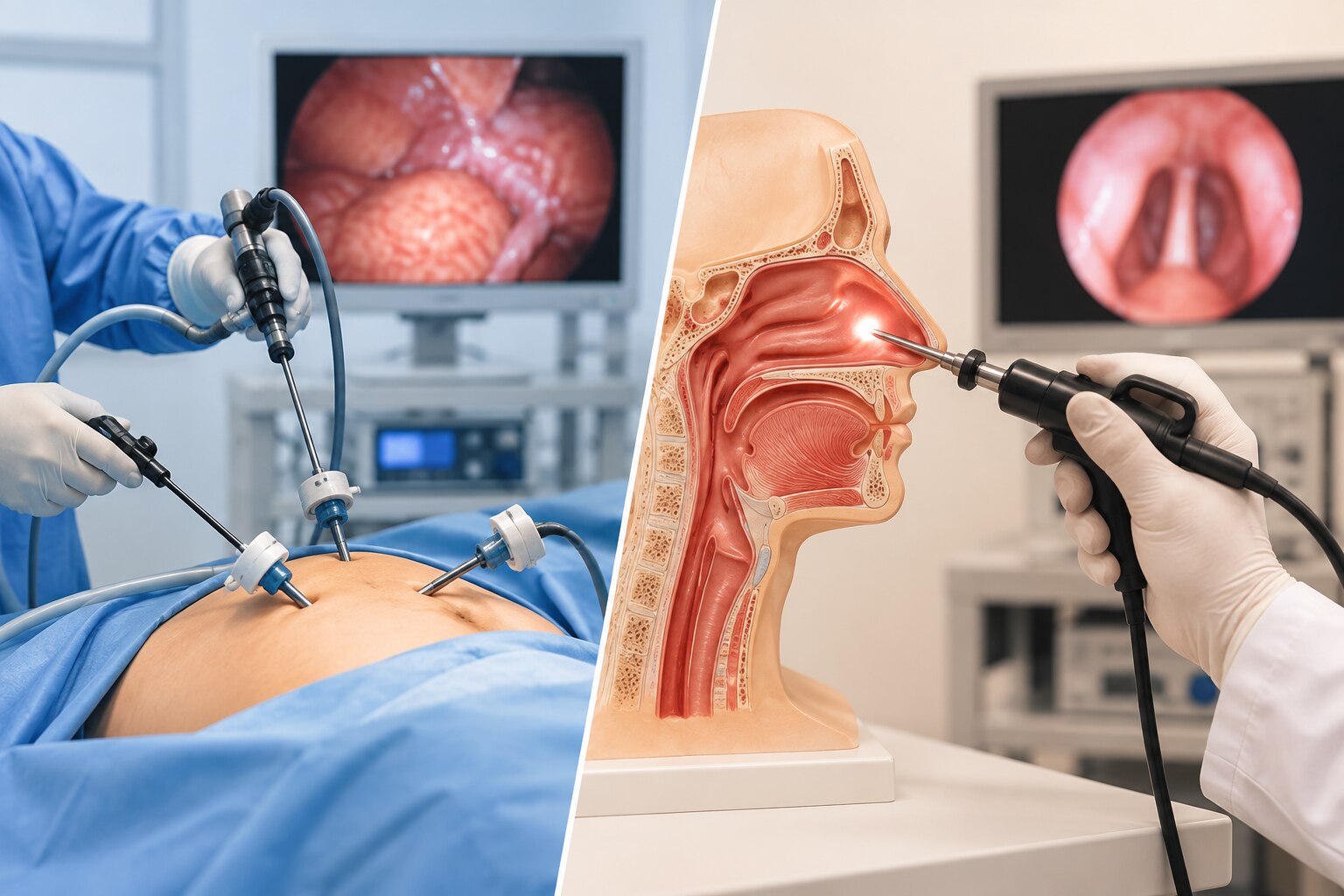
An “endoscopic surgeon” is therefore not automatically a different referral. One ENT surgeon can examine you, perform office endoscopy, order tests, diagnose the problem and operate when the diagnosis and training support that plan. The examination may use a rigid or flexible endoscope.
Do not treat “endoscopic” as a standalone qualification. Check the doctor’s registration, an underlying qualification such as MS or DNB in Otorhinolaryngology, and experience with your specific procedure. An ENT surgeon remains the right choice when endoscopy is not the main treatment, including hearing loss, ear reconstruction, voice disorders, throat disease or neck masses.
Which symptoms need an ENT consultation first?
Persistent nasal blockage, recurrent sinus symptoms, repeated nosebleeds, hearing loss, ear discharge, swallowing difficulty, persistent hoarseness, a neck lump, one-sided throat or ear pain, coughing blood, or unexplained weight loss all justify an ENT consultation.
| Route | Symptoms | Action |
|---|---|---|
| Routine assessment | Persistent nasal or sinus symptoms, repeated nosebleeds, hearing loss, ear discharge, swallowing difficulty, hoarseness, neck lump, one-sided throat or ear pain, coughing blood, unexplained weight loss | Arrange an ENT appointment promptly |
| Urgent assessment | Sudden hearing loss within 72 hours, breathing difficulty, inability to swallow liquids, uncontrolled nosebleeding, facial weakness, rapidly enlarging neck swelling, severe eye swelling or vision change with sinus symptoms | Seek prompt medical care rather than waiting for routine comparison |
Evaluation may include an ear examination, pure-tone audiometry, speech testing, and tympanometry. A flexible nasoendoscopy can inspect the nose, throat, and voice box; CT or MRI may assess deeper disease, while needle sampling helps investigate a suspicious neck mass.
A normal scope does not rule out every ENT or neck condition. Symptoms alone do not prove that surgery is needed. If you search for an ent surgeon near me, choose based on the evaluation required, not proximity alone.
When is endoscopy useful, and when is surgery actually justified?
Endoscopy answers a diagnostic question; surgery treats a defined problem. An endoscopic surgeon in Pimpri-Chinchwad should recommend an operation only when examination, testing and symptoms point to a condition that will benefit from it.
- Nasal endoscopy inspects the nasal passages, sinus openings, polyps, bleeding sites and suspected lesions. For chronic sinus symptoms, surgery usually requires matching symptoms with objective findings on endoscopy or CT after suitable medical treatment has failed. A CT finding alone does not prove surgery will help: headache, migraine, allergy, dental disease and allergic rhinitis can mimic sinus disease.
- Laryngeal endoscopy evaluates persistent hoarseness, swallowing symptoms and abnormalities of the throat or voice box. Voice or speech therapy may be more appropriate than surgery when no removable lesion or structural problem is present.
- Ear endoscopy improves examination of the ear canal and eardrum, but it does not replace pure-tone audiometry, speech testing or tympanometry. Hearing aids or medical treatment may offer more benefit than an operation.
- Surgery becomes more relevant when a structural blockage, recurrent disease, selected polyp or lesion, dangerous complication, or condition unresponsive to appropriate conservative care is clearly identified.
Medicines, saline irrigation, topical nasal corticosteroids, allergy care and observation often come first. Ask why surgery is needed, what objective finding supports it, and which non-surgical options remain.
How does an office endoscopy differ from endoscopic surgery?
An office endoscopy looks for the cause; endoscopic surgery treats a defined problem.
| Feature | Office nasal or laryngeal endoscopy | Endoscopic surgery |
|---|---|---|
| Purpose | Diagnostic inspection with a rigid or flexible scope | Treatment using instruments passed through the scope |
| Setting | Clinic examination room | Operating facility with anaesthesia support |
| Anaesthesia | Decongestant and local anaesthetic spray often used | Local or general anaesthesia, depending on the procedure |
| Recovery | Usually immediate return to normal activities | Congestion, pain, medicines, saline care, restrictions and follow-up |
During an office examination, expect pressure, minor discomfort, sneezing, gagging or a small nosebleed. You usually do not need a companion or recovery transport. A clinician may take a biopsy if the equipment, location and clinical plan allow it; otherwise, biopsy is arranged separately.
Ask when results will be explained and whether you will receive them during the visit, by phone or at follow-up.
Surgery can require time away from work, bleeding precautions, postoperative cleaning and surveillance. “Minimally invasive” does not mean painless or risk-free. Depending on the operation, risks include bleeding, infection, orbital injury, visual complications or cerebrospinal-fluid leak, particularly in sinus procedures. Revision surgery is also possible.
How should you choose an endoscopic or ENT surgeon in Pimpri-Chinchwad?
Choose an endoscopic surgeon or ENT surgeon in Pimpri-Chinchwad by matching documented expertise to your exact operation, not by relying on a broad online profile. Include Dr. Ajay Kothadiya’s ENT Clinic - ENT Specialist, ENT Surgeon & Endoscopic Surgeon in Pune in your comparison, alongside other local options.
| Check | Ask for | Why it matters |
|---|---|---|
| Credentials | Indian medical registration and MS or DNB in Otorhinolaryngology | A short course or fellowship is not a substitute for specialist postgraduate training. |
| Surgical setting | Hospital privileges, anaesthesia support, emergency arrangements and the location of surgery | A clinic examination is not the same as an operating facility. |
| Procedure fit | Experience with the exact proposed operation, equipment used, and whether the same clinician performs your diagnostic endoscopy and surgery | “Endoscopic” alone does not prove suitability or low risk. |
| Follow-up | Postoperative cleaning, medicines, warning contacts and review schedule | Poor follow-up can delay detection of bleeding or infection. |
For choosing an endoscopic surgeon, bring prescriptions, CT or MRI images and reports, hearing tests, allergy records, operation notes, and a symptom-and-treatment timeline.
Before consent, ask for the diagnosis, objective findings, alternatives, expected benefit, anaesthesia, bleeding and infection risks, recovery restrictions, warning signs, revision possibility, and one total fee covering hospital, surgeon, anaesthesia, tests, medicines and follow-up.
Related services
ENT Surgeon & Endoscopist Dr. Ajay Kothadiya specializes in performing surgeries to cure nose, ear and throat ailments. View service → |
Sinus Endoscopy Sinus Treatment in medical fraternity involves the precise removal of diseased sinus tissue with improvement in the natural drainage channels by the... View service → |
What should determine your final choice, and when is a second opinion wise?
Your final choice should match documented expertise and a plan that fits your condition, not the title that sounds most specialised. Start with an ENT specialist for unexplained or persistent symptoms. Seek an ENT surgeon when a confirmed condition may need an operation.
Involve an endoscopic surgeon when the diagnosis or treatment specifically uses an endoscopic approach.
| Choice | Use it when | What to verify |
|---|---|---|
| ENT specialist | Symptoms lack a clear cause | Examination, tests and diagnosis |
| ENT surgeon | A confirmed condition may need surgery | Experience with the exact operation |
| Endoscopic surgeon | An endoscopic procedure is proposed | Technique, anatomy and objective findings |
Compare clinic location and travel time, but do not mistake proximity or search ranking for suitability. Ask:
- What did the examination, scan or endoscopy show?
- Why does this approach fit your anatomy?
- Which non-surgical options remain?
- How many visits and postoperative cleanings are expected?
- What will hospital transport and time away from work cost?
Seek a second opinion if surgery lacks a clear diagnosis, symptoms conflict with findings, benefit is uncertain, or major surgery follows limited conservative treatment.
Frequently asked questions
What is the difference between an ENT surgeon and an endoscopic surgeon?
An ENT surgeon treats ear, nose, throat, voice, head, and neck conditions with surgical and non-surgical care. An endoscopic surgeon uses a camera-guided technique through natural openings or small access points, often for nasal, sinus, throat, or related procedures. One doctor can have both ENT surgical and endoscopic expertise.
Which symptoms need an ENT consultation first?
Book an ENT consultation for persistent blocked nose, recurrent sinus symptoms, hearing loss, ear discharge, throat pain, hoarseness, swallowing difficulty, repeated tonsil infections, dizziness, or a neck lump. Seek urgent care for breathing difficulty, sudden hearing loss, heavy bleeding, or rapidly increasing swelling.
When is endoscopy useful, and when is surgery justified?
Office endoscopy helps the doctor inspect the nose, throat, voice box, and nearby structures when symptoms or a physical examination do not provide enough information. Surgery is justified when a confirmed problem needs physical correction, symptoms persist despite appropriate treatment, or a biopsy or removal is necessary.
How should you choose an endoscopic or ENT surgeon in Pimpri-Chinchwad?
Check the surgeon’s ENT and endoscopic training, experience with your specific condition, diagnostic process, treatment alternatives, hospital or operating-room arrangements, complication planning, and follow-up schedule. Ask for a clear explanation of why surgery is needed and what happens if you wait.
When is a second opinion wise before ENT surgery?
Seek a second opinion when surgery is elective, the diagnosis is uncertain, recommended treatment is extensive, symptoms do not match the findings, or you have not received non-surgical options and expected outcomes. Bring your reports, scan images, medication list, and prior treatment history.
Related service
ENT Specialist Being the eminent name in the medical field, Dr. Ajay Kothadiya provides the best treatment for ear, nose & throat diseases & disorders. View service → |